
Phone: (647) 894 7706
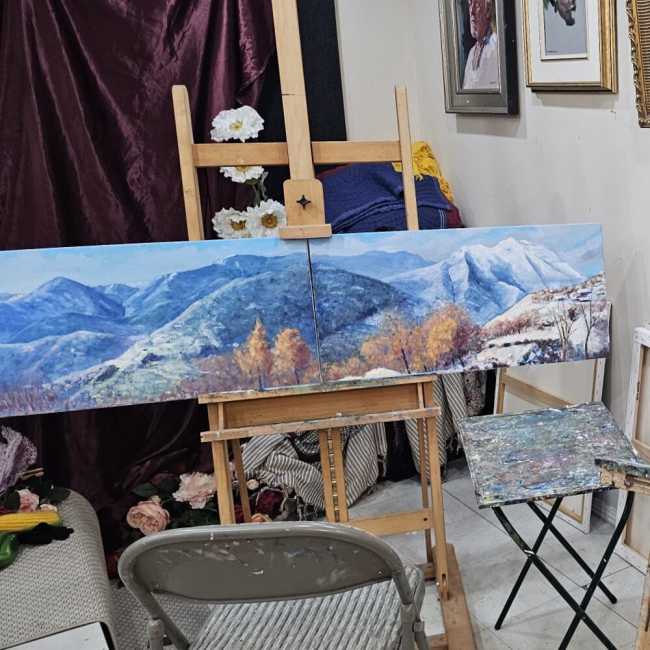
Landscape painting brings its own challenges. Beginners, while trying to capture scenery on canvas, tend to go overboard with detailing. While the effort is commendable, including everything one sees is strictly not necessary.
Every rock, every tree, and every cloud does not need to find its way into the artwork. Adding too many details results in the painting losing its focus, thereby turning into a messy blur.
At VR School of Art’s landscape painting lessons in Toronto, we help students understand that it is not about painting more – it is about carefully choosing the details that matter.
In today’s blog, we will discuss how simplification actually brings clarity to landscape paintings.
The goal is not to paint fewer trees or reduce the number of clouds in the sky. Instead, it is to exercise discretion when choosing which elements to keep and which to omit. Here is what we help students grasp during our oil painting lessons:
“Less is more” in the world of landscape painting. Too much information can weaken the essence of an artwork, as it does not offer any specific point to focus on. Instead of crowding the painting with extra elements, focus on capturing the atmosphere of a natural scene.
The primary area of interest in a painting depends on the scene one is trying to capture. For example, if the landscape is dotted with mountains, the mountain edge will automatically become its focal point. However, we encourage students to exercise free thinking and choose their primary area of interest so that they can build the rest of the painting around it.
Our art lessons in Toronto also teach students to group details into larger categories and shapes. Instead of painstakingly detailing each blade of grass, leaves can be clubbed together to create a sense of shrubs and ensure the final painting has a strong visual hierarchy that makes it look more cohesive and complete.
With landscape painting, the idea is to represent the beauty of a scene as truthfully as possible. This does not mean randomly omitting information, but rather making intentional choices that highlight the natural aesthetics of the scene without trying too hard.
At VR School of Art, Toronto’s leading art school, we teach students perspectives, shapes, textures, and critical thinking so they can create artwork they would be proud of. Contact us or visit our North York studio to learn more about our classes.
No. They use their imagination and distinct art style to adjust, combine, or simplify references. This helps them create more visually balanced compositions.
Landscape paintings with selective detailing tend to look more realistic because they are less visually cluttered and overwhelming for viewers.
Not necessarily. As long as the painting faithfully captures the atmosphere, depth, and clarity of the scene, it will look visually complete.